
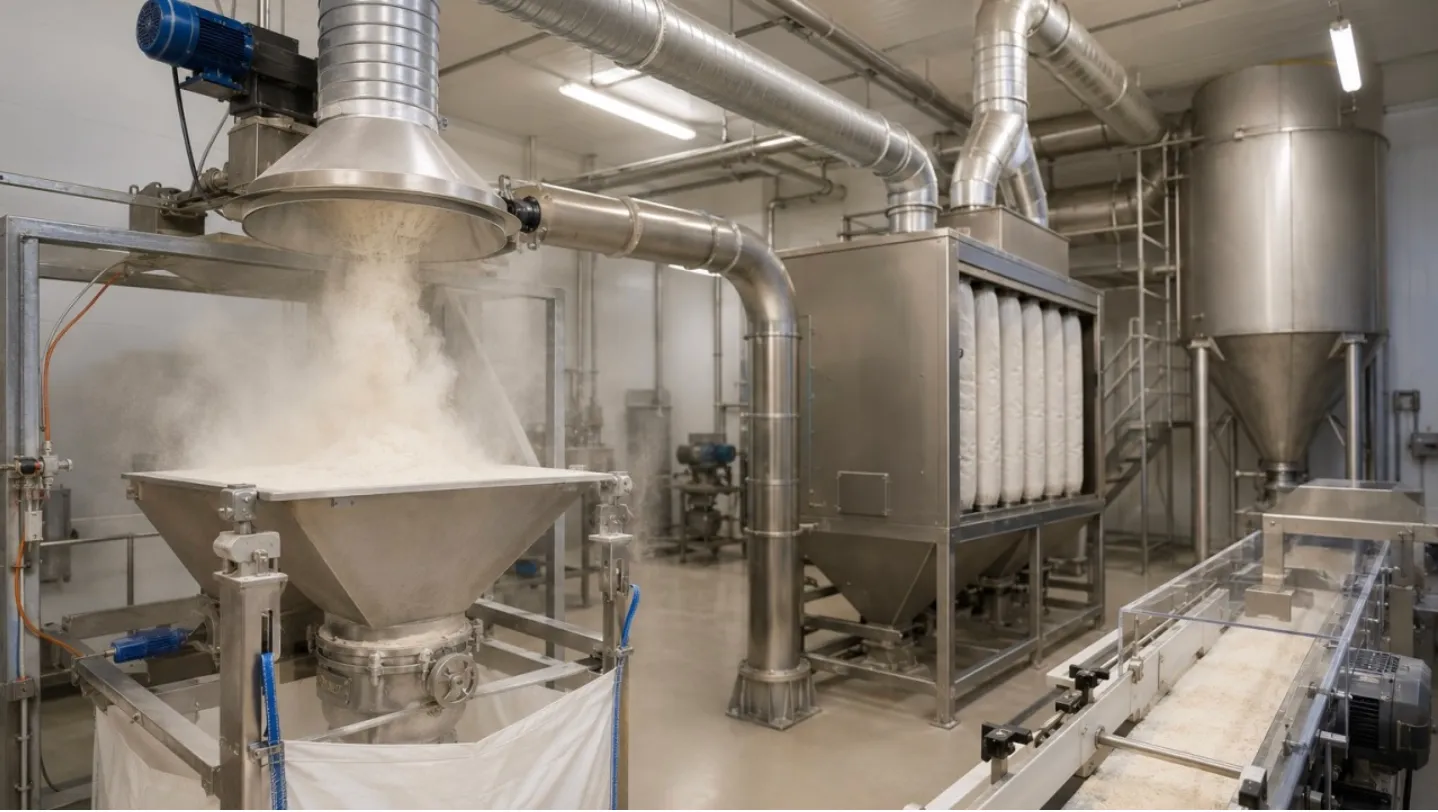
Food industry and explosion risk: ventilation is not just a drawing note
In the food industry, explosion risks are still too often associated only with visible dust clouds. That is a dangerous simplification. During audits, installations that appear clean and well controlled can still prove to be insufficiently substantiated from a ventilation and dust-control perspective.
In practice, the discussion often stops at the hazardous area classification drawing. The more important question is different: is the concentration of combustible dust actually being controlled during normal operation, foreseeable malfunctions, cleaning, maintenance and product changeovers?
In processes involving flour, starch, sugar, milk powder, cocoa, spices or other organic powders, dust release does not occur only during primary process steps. Significant emissions often arise during secondary operations such as big-bag emptying, transfer points, sieve decks, belt conveyors, manual dosing, filter handling and pneumatic conveying. In theory, these sources of release are known. In practice, product properties, moisture content, filter condition, extraction performance and negative pressure conditions change continuously.
Under the European ATEX workplace framework, the employer must assess explosion risks and prevent or mitigate the formation of explosive atmospheres. In the UK, the same operational obligation is reflected through DSEAR. For dust hazardous area classification, IEC/EN IEC 60079-10-2 provides the technical framework for identifying and classifying areas where explosive dust atmospheres and combustible dust layers may be present. Ventilation or local extraction may only be relied upon as a risk-reducing measure when its effectiveness, availability and maintenance condition are demonstrable.
That is where things often go wrong in the food industry. An extraction point that was correctly designed during commissioning may deliver only a fraction of its original air volume years later because of contamination, incorrect damper positions, increased filter resistance, damaged ductwork, poor capture geometry or undocumented modifications.
Consider a big-bag discharge station for starch in a food production environment. During emptying, dust release can occur around the discharge outlet, connection points and product interface. If measurements or operating experience indicate a dust release rate of approximately 0.8 g/s, the extraction system must be designed so that the airborne dust concentration remains well below a dangerous explosive atmosphere.
If a conservative design target of 25% of the minimum explosible concentration is used, and an indicative MEC of 60 g/m³ is assumed for an organic food dust, the target concentration becomes 15 g/m³. On that basis alone, 0.8 g/s corresponds to approximately 192 m³/h of theoretical dilution air. On paper, that may still appear manageable. In reality, however, the design must also account for capture efficiency, leakage, pulsed emissions, product variation, dust deposits, operator behaviour, filter loading and degradation of extraction performance. For that reason, an effective local extraction design may easily require 400–800 m³/h, depending on enclosure design, source geometry and actual process behaviour.
This immediately shows why many existing food installations are insufficiently substantiated. A site may have a hazardous area classification drawing, but no demonstrable ventilation calculation, no validation of actual extraction performance and no evidence that the system still controls the explosive atmosphere under real operating conditions. From an audit, insurance or regulatory perspective, that is becoming increasingly difficult to defend.
A second underestimated risk is dust-layer formation. Even when ventilation appears sufficient to limit visible dust clouds, secondary dust deposits may accumulate on cable trays, beams, machine frames, filters, ledges and floors. In food environments with organic dusts, even relatively thin layers can become relevant when disturbed, dispersed and mixed with air. Ventilation must therefore never be treated as an isolated measure. It has to be part of an integrated control concept that also includes housekeeping, inspection, maintenance, equipment integrity, change control and operational discipline.
The direction of explosion safety is shifting from documentation alone towards demonstrable performance. The decisive question is not whether an extraction system is present. The decisive question is whether that system still controls the explosive atmosphere under the operating conditions that actually occur.
That distinction is becoming increasingly important during ATEX assessments, DSEAR reviews, insurer inspections, SEVESO/COMAH-related audits and internal process safety reviews.
Explosion safety in the food industry is therefore not proven by a clean-looking installation or by a drawing in a folder. It is proven by the ability to demonstrate that dust release, ventilation, dust layers, ignition sources and maintenance condition remain under control in practice.
https://exquintia.com/
#ATEX #DSEAR #ExplosionSafety #DustExplosion #FoodIndustry #ProcessSafety #IEC60079 #HazardousAreas #CombustibleDust #DustHazard #COMAH #SEVESO #RiskAssessment #IndustrialSafety #Exquintia